logo
Good price  online

products details

Created with Pixso. Home Created with Pixso. Products Created with Pixso.
Glass Melting Furnace
Created with Pixso. 300 tpd Flint Glass Melting Furnace with Energy Saving and Natural Gas Fuel

300 tpd Flint Glass Melting Furnace with Energy Saving and Natural Gas Fuel

Brand Name: JEFFER
Model Number: Customized
MOQ: 1 set
Price: Negotiable
Delivery Time: 90 days after received the down payemnt
Payment Terms: T/T,L/C
Detail Information
Place of Origin:
China
Certification:
ISO9001, ISO14001, ISO45001
Capacity:
300 Tpd
Material:
Fused AZS, Silica Brick
Kind Of Glass:
Soda-lime
Color:
Flint
Condition:
New
Kind Of Fuel:
Natural Gas
Consumption:
Energy Saving
Warranty:
One Year
Application:
Glass Industry
After-salses Service:
Engineering Overeas Service Available
Melting Temperature:
1500 To 1700°C
Furnace Type:
End Fired Regenerative Furnace, Cross Fired Regenerative Furnace, Recuperative Furnace, Full-Oxygen Furnace, Electric Furnace
Packaging Details:
Wooden case, tray, steel frame, etc
Supply Ability:
1 set per 3 months
Highlight:

300tpd Glass Melting Furnace

,

300tpd small glass tempering furnace

,

ISO9001 Glass Melting Furnace

Product Description
Large Capacity 300 Ton Flint Glass Melting Furnace Energy Saving
Product Overview

Glass melting furnace refers to the thermal equipment used in glass manufacturing to melt glass mixtures. This process involves mixing prepared powder according to the glass composition with added cullet (broken glass) at high temperature in the kiln to melt, clarify, and form glass liquid that meets forming requirements.

Glass manufacturing has a history of 5000 years, with traditional methods using firewood as fuel and melting glass materials in clay jars. Modern development began in 1867 when Germany built the first continuous coal-fired tank furnace, with rapid advancements occurring after 1945.

Glass melting is defined as the process where raw materials are heated to temperatures between 1500 to 1700°C, undergoing chemical reactions to transform into molten glass within a furnace. This continuous process involves raw material introduction that mixes with molten glass, facilitated by natural convection and gas reactions.

Large Capacity 300 Ton Flint Glass Melting Furnace
Types of Glass Melting Furnace
  • End fired regenerative furnace
  • Cross fired regenerative furnace
  • Recuperative furnace
  • Full-Oxygen furnace
  • Electric furnace
Process Steps
Silicate Forming

Raw batch materials are heated and chemical reactions take place to generate silicate sinter with residual silica, which lays foundation for subsequent glass liquid formation.

Glass Liquid Forming

In this stage, the sinter melts and the silicate and SiO2 in sinter transform into flint glass liquid with numerous bubbles. However, chemical components and characteristics are not yet uniform.

Clearing

The glass liquid is continuously heated, reducing its viscosity and releasing gaseous impurities. This process eliminates visible bubbles within the liquid pool.

Homogenization

The glass liquid is maintained at high temperature for extended periods, eliminating striae through diffusion function and achieving complete homogenization. Homogenization temperature can be lower than the clearing stage.

Furnace Structure
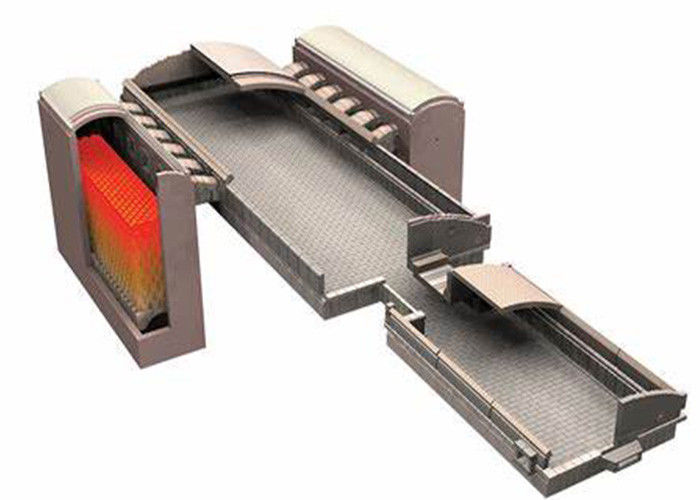
  • Melting Section: The part that melts batched materials while clearing and homogenizing glass liquid. The upper space is the flame space, while the lower part is the melting tank.
  • Dog House: Batched materials feed into the furnace through the dog house, with heat transferred via flame space to the glass liquid.
  • Air, Gas Access: Heated air and gas flow into the pre-combustion room for mixing after exiting the regenerator. This also serves as access for flue gas to flow into the regenerator from the flame space.
  • Port: Critical furnace component where fuel mixes with preheated air, serving as access for preheated air into the furnace and for exhausting waste gas.
Furnace Melting Technology System

Furnace melting technology includes temperature, pressure, bubbling, glass liquid level, fuel, and reversing systems.

Item Description
Temperature Refers to the temperature of the melting tank, not the entire furnace. Temperature distribution extends from the melting tank through the furnace length.
Pressure Furnace pressure represents the static pressure of the gas system, determined by pressure distribution curve.
Bubbling Stable shape and position of bubbles are important indicators for estimating melting performance, affecting furnace production capacity and glass liquid quality.
Frequently Asked Questions
Q: Who we are?
A: JEFFER Engineering and Technology Co., Ltd is a professional engineering company specializing in project design, engineering technology consulting, engineering, procurement, construction (EPC), and project operation management.
Q: Can you customize the products?
A: Yes, we have an experienced professional team ready to make designs according to customer requirements.
Q: Do you offer installation on site overseas?
A: Yes, we can provide our engineer to supervise installation work on site or provide a complete installation team to finish the project.
Q: Confidential protection provide?
A: Strict drawing management system eliminates the risk of leakage and protects your interests.
300 tpd Flint Glass Melting Furnace with Energy Saving and Natural Gas Fuel