logo
Good price  online

products details

Created with Pixso. Home Created with Pixso. Products Created with Pixso.
Float Glass Production Line
Created with Pixso. 250TPD Float Glass Production Line Glass Forming Machinery for Glass Industry

250TPD Float Glass Production Line Glass Forming Machinery for Glass Industry

Brand Name: JEFFER
Model Number: Customized
MOQ: 1 Set
Price: Negotiable
Delivery Time: 180 Days After Receiving The Down Payment
Payment Terms: T/T,L/C
Detail Information
Place of Origin:
Chongqing, China
Certification:
ISO9001, ISO14001, ISO45001
Capacity:
Customized
Color:
Clear
Product Name:
Float Glass
Application:
Construction
Voltage:
380V
Thickness:
Customized
Condition:
New
Dimension:
Customized
Warranty:
One Year
After-Sales Service:
Engineering Overseas Service Available
Packaging Details:
Wooden Case, Tray, Steel Frame, Etc
Supply Ability:
2 Sets Per Annually
Product Description

250TPD Float Glass Production Line Glass Forming Machinery for Glass Industry


1. Overview

The fundamental principle of float glass production lies in directing high-temperature molten glass onto the surface of molten tin. Leveraging the high density and perfectly flat surface of the tin liquid, the glass naturally spreads, polishes, and forms under the combined effects of gravity and surface tension. This process fundamentally avoids the thickness unevenness caused by traditional mechanical roll-forming methods, significantly widening the glass ribbon and greatly increasing the pulling speed, thereby establishing a solid technical foundation for large-scale, continuous flat glass production.

Glass produced by this process exhibits excellent optical distortion control and minimal waviness. Its surface quality and internal uniformity are sufficient to meet the stringent requirements of high-end processing applications. A complete float glass production line typically encompasses five core process stages: batch preparation, high-temperature melting, tin bath forming, annealing treatment, and cold-end cutting and stacking. By completing spreading and polishing at high temperatures on the tin liquid surface, the product achieves superior parallelism and optical transmission performance.


2. Performance Characteristics

Since the glass ribbon is formed on the tin liquid surface, both the upper and lower surfaces receive a high-temperature "fire-polishing" effect, yielding a surface finish comparable to mechanical grinding. Moreover, compared with mechanically ground glass, float glass retains a complete surface compression layer, offering higher mechanical strength and better weather resistance and chemical durability, making it less prone to scratches or performance degradation over long-term service.


3. Thickness Specifications and Applications

 
No. Thickness Typical Applications
1 2mm, 3mm, 4mm, 5mm, 6mm Building windows and doors; automotive side windows and sunroofs
2 2mm, 3mm, 5mm, 6mm Silver mirror processing; decorative mirrors
3 8mm, 10mm Curtain walls; interior partitions; display cases
4 12mm Large floor-to-ceiling windows; shop display windows
5 15mm Load-bearing glass structures; stair treads
6 19mm Specialty protective glass; high-end architectural facades

4. Raw Material System

The primary mineral raw materials and chemical auxiliaries involved in float glass production include:

 
No. Raw Material Functional Role
1 Silica Sand Supplies SiO2 to form the glass network skeleton
2 Dolomite Introduces MgO and CaO to improve chemical stability
3 Limestone Provides CaO to adjust melting temperature and viscosity
4 Feldspar Supplies Al2O3 to enhance mechanical strength
5 Soda Ash Acts as a flux to lower the melting temperature
6 Salt Cake Serves as a fining agent to eliminate bubbles and striae
7 Cullet Accelerates melting and conserves energy consumption

5. Process Flow of Float Glass Production Line

After precise weighing and efficient mixing, the batch materials are continuously fed into the melting furnace by a batch charger. Under high temperatures, the batch materials melt into homogeneous glass liquid, which flows through a canal into the tin bath, where spreading, polishing, and thickness control take place on the tin surface. When the glass ribbon cools to approximately 600°C, it passes through a transition roller table into the annealing lehr, where internal thermal stresses are eliminated under precisely controlled temperature conditions. After annealing, the glass ribbon undergoes online quality inspection, computer-optimized cutting, automatic snapping and separation, and finally is stacked and packed by the stacking system to form finished products ready for shipment.


6. Main Equipment Description

6.1 Batch Plant
Responsible for storage, weighing, mixing, and conveying of various mineral raw materials, supplying the melting furnace with consistently composed and well-mixed batch materials.

6.2 Melting Furnace
The melting tank is the thermal core of the entire production line. The selection and installation quality of its refractory linings directly determine furnace service life and glass melting quality. High-corrosion-resistant materials such as fused-cast zirconia-alumina must be employed.

6.3 Tin Bath
The tin bath is the most technically critical piece of equipment in the float process. After continuously flowing into the tin bath, molten glass floats on the surface of tin liquid (density 7.3 g/cm3). Through the combined actions of gravity, surface tension, and mechanical top rollers, the glass undergoes sequential spreading, polishing, thinning, and cooling setting, ultimately forming a continuous glass ribbon with uniform thickness and a flat surface. The equipment features a structurally stable design that ensures a uniform temperature field across the tin liquid, promoting even spreading and rapid shaping of the glass.

6.4 Protection Gas Station
The protection gas station must operate continuously around the clock to stably produce and supply the high-purity protective atmosphere required for the tin bath. Typically, a mixture of nitrogen (N2) and hydrogen (H2) gases is used as the protective medium, primarily to prevent oxidation of the tin liquid at high temperatures and ensure a clean tin surface.

Nitrogen is a colorless, odorless inert gas that exists in a free state in nature. It is non-combustible and poorly soluble in water, effectively isolating oxygen without reacting with tin. Hydrogen, on the other hand, is the lightest reducing gas, possessing strong reducing capabilities and high chemical activity. It reacts with trace oxides on the tin surface to form water vapor, which is exhausted with the off-gas, while its high thermal conductivity also aids in temperature equalization within the tin bath roof space.

6.5 Annealing Lehr
The core objective of the annealing process is to eliminate permanent stresses and optical inhomogeneity within the float glass ribbon caused by uneven thermal history, thereby stabilizing the glass structure and ensuring high yield rates during cutting and subsequent processing.

Annealing is essentially a precision temperature-controlled cooling process. The cooling rate must be set according to different thicknesses and product grades, ensuring that residual stresses remain within the allowable limits specified by national standards. Simultaneously, temporary stresses generated during annealing must be strictly controlled to prevent glass breakage within the lehr due to excessive stress.

6.6 Cold-End Processing System
The cold end of the float production line undertakes online quality inspection, cutting, snapping, stacking, and packaging of the glass ribbon, and is generally divided into three major functional zones:

  • Inspection and Pre-treatment Section: Performs optical quality inspection, defect identification, and marking.

  • Cutting and Breaking Section: Conducts longitudinal and transverse cutting according to order dimensions, automatic snapping, and edge grinding.

  • Stacking and Packaging Section: Stacks finished glass sheets mechanically or via air flotation, followed by moisture-proof and scratch-proof packaging.

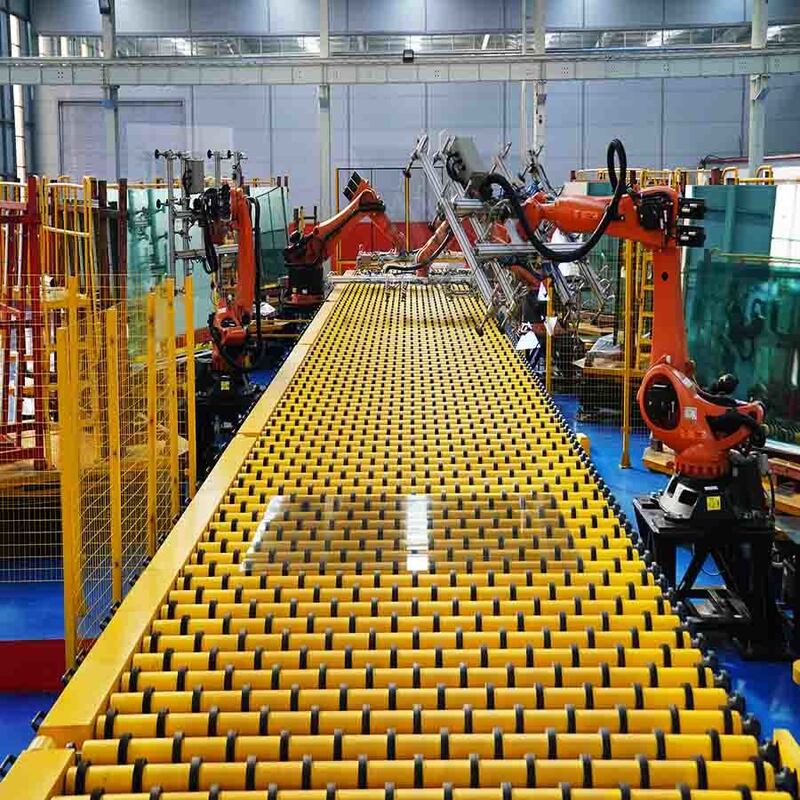
The cold-end automation system can be further subdivided into emergency handling zone, quality inspection and grading zone, optimized cutting zone, spacing separation zone, acceleration conveying zone, and cullet recovery zone. Among these, the emergency zone is located between the annealing lehr outlet and the main conveyor table, enabling rapid glass disposal under abnormal conditions through cutting and falling plate equipment. The quality inspection zone employs online inspection instruments to assess defect types and density with automatic marking. The separation zone uses servo motors to precisely control roller speeds, achieving safe spacing between glass sheets and creating necessary conditions for subsequent stacking and packaging.


FAQ

Q: What is your company's business scope?
A: JEFFER Engineering and Technology Co., Ltd is a professional engineering company specializing in project planning, engineering technology consulting, design-procurement-construction (EPC) turnkey services, and production operation management.

Q: Can you provide customized design services?
A: Yes. We have an experienced technical team capable of developing comprehensive engineering solutions and construction drawings based on the product specifications and quality requirements provided by our clients.

Q: How can I obtain a quotation for equipment or engineering services?
A: For production line equipment, please provide detailed specifications of the products you intend to manufacture (such as thickness range, target capacity, and product applications), and we will prepare an economic proposal for your reference. For engineering services, please describe your project requirements, and we will provide a detailed schedule and execution plan.