logo
Good price  online

products details

Created with Pixso. Home Created with Pixso. Products Created with Pixso.
Cross Fired Furnace
Created with Pixso. High Efficiency 380V Cross Fired Glass Melting Furnace with Customized Capacity

High Efficiency 380V Cross Fired Glass Melting Furnace with Customized Capacity

Brand Name: JEFFER
Model Number: Customized
MOQ: 1 Set
Price: Negotiable
Delivery Time: 180 Days After Receiving The Down Payment
Payment Terms: T/T,L/C
Detail Information
Place of Origin:
China
Certification:
ISO9001, ISO14001, ISO45001
Frequency:
50Hz
Voltage:
380V
Fuel:
Gas
Daily Capacity Range:
50 - 750 T/d (customizable)
Installed Power:
800 - 1,000 KW (typical)
Fuel Types:
Natural Gas, LPG, Or Fuel Oil
Packaging Details:
Wooden Case, Tray, Steel Frame, Etc
Supply Ability:
1 Set Per 6 Months
Product Description
High Efficiency Cross Fired Glass Melting Furnace 380V
1. Product Overview

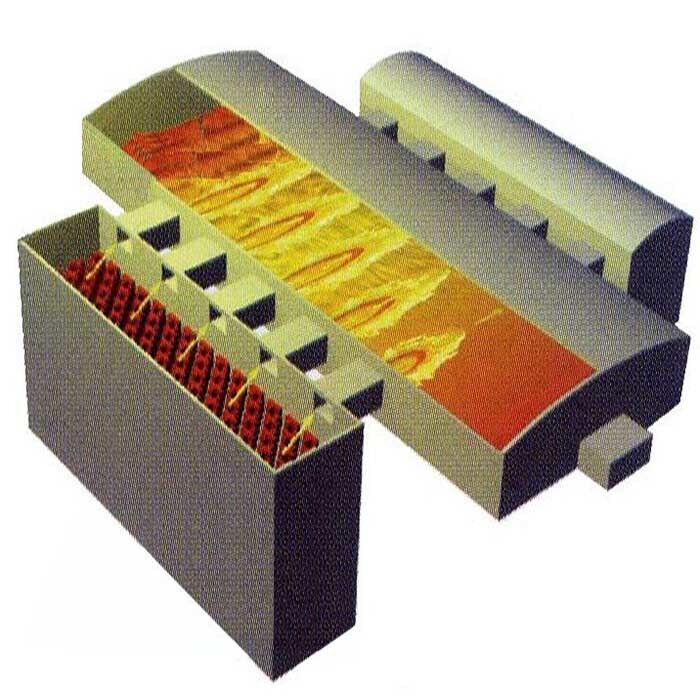
The cross-fired furnace represents a sophisticated thermal system in which burner arrays are installed on opposite sidewalls, generating flames that traverse the melting tank horizontally—perpendicular to the glass flow direction. This configuration produces a sweeping heat current across the batch surface, significantly enhancing radiative and convective heat transfer. As a core asset in modern glass manufacturing, this furnace type aligns with global trends toward decarbonization and operational cost reduction, effectively balancing higher output with controlled CO₂ and NOx emissions.
Compared to end-fired designs, the cross-fired layout allows for a broader melting zone and larger overall furnace dimensions, making it particularly suitable for medium-to-large-scale production lines. Typical daily melting capacities range from 250 to 500 tonnes, with engineered upgrades enabling stable operation at 750 t/d or beyond. While energy consumption is marginally higher than that of end-fired furnaces—due to the larger combustion space—the integration of a regenerative heat recovery system ensures excellent thermal efficiency and rapid responsiveness to load changes, keeping overall fuel usage competitive.

2. Key Features & Advantages
  • Superior Temperature Field Control – Opposed flame projection minimizes localized overheating, reducing refractory stress and glass defects while improving melt homogeneity.

  • Flexible Zonal Heating – Independent burner control along the furnace length allows precise longitudinal temperature profiling, accommodating diverse glass compositions and pull-rate variations.

  • Scalable Throughput – Engineered for continuous 24/7 operation, with capacity options tailored from 50 tpd up to 750 tpd, meeting both niche and mass-production demands.

  • Regenerative Efficiency – The twin-regenerator system alternately preheats combustion air to high temperatures, recovering waste heat and lowering specific energy consumption per ton of glass.

  • Dual-Deck Reversing Mechanism – Ensures smooth and reliable flow direction switching, extending equipment life and maintaining stable combustion conditions.

3. Structural Composition

The furnace system is architecturally divided into interdependent functional zones:
Melting Tank – Integrates both the batch melting area and the refining/fining zone, constructed from high-grade fused-cast AZS refractories.
Breast Wall – Supports the crown and provides lateral enclosure for the flame space.
Crown – The arched silica-based roof that reflects radiant heat back onto the melt.
Ports – Passages for fuel-air mixture entry and flue gas exit, strategically positioned on each side.
Regenerators – Twin chamber systems packed with checker bricks, cyclically storing and releasing heat to preheat incoming combustion air.
Cooling Section – A downstream zone for gradual temperature reduction before conditioning or forming.
Flue Channel – Collects exhaust gases from multiple ports and directs them to the reversing unit.
Double-Deck Reversing Unit – Automates the alternating firing and exhausting cycles for continuous operation.
Waste Heat Treatment System – Optional downstream equipment for further heat recovery or emission scrubbing.

4. Core Component Specifications
  • Melting Tank
    A combined structure serving both melting and clarification functions, lined with high-temperature-resistant materials to withstand aggressive glass corrosion.

  • Regenerator
    Acts as the primary waste-heat recovery unit. Ambient air is drawn through the hot checkerwork, achieving preheating temperatures that significantly reduce fuel demand before entering the ports.

  • Port Assembly
    The critical mixing point where fuel (gas or oil) meets preheated combustion air. It also functions as the entry for hot air into the furnace and the exit for spent combustion gases during the reverse cycle.

5. Technical Parameters (Reference)
ParameterSpecification
Daily Capacity Range50 – 750 t/d (customizable)
Standard Voltage380V (3-phase, 50/60Hz)
Installed Power800 – 1,000 kW (typical)
Investment ReferenceUSD 10 – 12 million (scope-dependent)
Fuel TypesNatural gas, LPG, or fuel oil
6. Frequently Asked Questions

Q: What is JEFFER's core business?
A: JEFFER Engineering and Technology Co., Ltd is a full-service engineering provider specializing in project feasibility studies, detailed engineering design, procurement, EPC turnkey contracting, and long-term operation management for glass industry facilities.
Q: Can the furnace design be customized to our specific production needs?
A: Absolutely. Our in-house engineering team works closely with clients to tailor furnace dimensions, burner layout, regenerator sizing, and control systems to match your target capacity, glass type, and fuel availability.
Q: Do you provide overseas installation support?
A: Yes. We offer flexible on-site services ranging from technical supervision and commissioning guidance to deploying a complete installation crew, ensuring smooth project execution worldwide.
Q: How do you protect our proprietary information?
A: We operate under a strict drawing and documentation management protocol, with non-disclosure agreements and access controls to safeguard all client-specific data and process know-how.