logo
Good price  online

products details

Created with Pixso. Home Created with Pixso. Products Created with Pixso.
Float Glass Production Line
Created with Pixso. 150 TPD Float Glass Manufacturing Line with Precision Tin Bath and Automated Annealing Lehr

150 TPD Float Glass Manufacturing Line with Precision Tin Bath and Automated Annealing Lehr

Brand Name: JEFFER
Model Number: Customized
MOQ: 1 Set
Price: Negotiable
Delivery Time: 180 Days After Received The Down Payment
Payment Terms: T/T,L/C
Detail Information
Place of Origin:
China
Certification:
ISO9001,ISO14001,ISO45001
Packaging Details:
Wooden Case, Tray, Steel Frame, Etc
Supply Ability:
2 Sets Per Annually
Product Description
150 TPD Float Glass Manufacturing Line and Forming Equipment
1.Overview
The 150 TPD Float Glass Manufacturing Line is a complete production system designed for high-efficiency flat glass output, with a daily capacity of 150 metric tons. The core forming equipment - a precision tin bath - ensures superior surface quality and dimensional accuracy, making this line ideal for both architectural and automotive glass applications.
Float glass is produced by continuously pouring molten glass onto a bath of liquid tin, where it spreads, levels, and solidifies into a flawless ribbon. This method eliminates surface distortions and delivers exceptional flatness, which is why over 90% of the world's flat glass is now made via this process. Our 150 TPD line incorporates advanced automation and robust mechanical design to guarantee stable operation, low defect rates, and easy maintenance.

2.Key Features
  • Outstanding optical clarity - no waviness or distortion, comparable to polished glass
  • Uniform thickness - achieved through precise control of tin bath temperature and pull speed
  • High mechanical strength & chemical durability - superior to conventional ground/polished glass
  • Versatile thickness range - from 2 mm to 19 mm, suitable for windows, mirrors, furniture, and solar panels
  • Fully integrated line - from batching to cold-end packing, with PLC-based central control

3.Manufacturing Process (Core Steps)
The production flow is streamlined into five essential stages:
  1. Batching - Raw materials are accurately weighed, mixed, and conveyed to the furnace
  2. Melting - The batch is melted in a regenerative furnace at ~1600°C to form homogeneous molten glass
  3. Tin-Bath Forming - The molten glass is delivered onto a molten tin pool where it spreads under gravity and surface tension, producing a continuous glass ribbon with a fire-polished surface
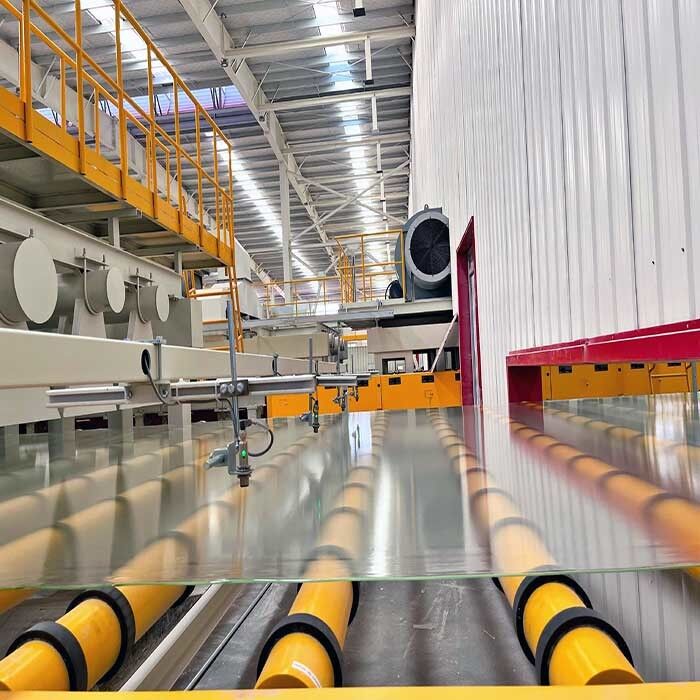
  4. Annealing - The ribbon passes through a long lehr where temperature is carefully reduced to relieve internal stresses
  5. Cold-End Processing - After online quality inspection, the glass is cut, separated, stacked, and packed automatically

4.Main Equipment Highlights
  • Batch Plant - Fully automated weighing and mixing system with dust collection, ensuring precise recipe consistency
  • Melting Furnace - Built with high-grade fused-cast refractories, offering long campaign life and energy efficiency
  • Tin Bath (Forming Equipment) - The heart of the line, designed with stable structural shell and advanced temperature zoning
  • Protection Gas Station - Continuously supplies nitrogen and hydrogen mixture to prevent tin oxidation
  • Annealing Lehr - Customized cooling curve based on glass thickness for optimal stress relief
  • Cold-End Section - Modular design comprising inspection, cutting, breaking, and stacking stations

5.Thickness & Typical Applications
Thickness (mm) Main Applications
2, 3, 4, 5, 6 Windows, automotive glazing, picture frames
8, 10, 12, 15 Shopfronts, interior partitions, table tops
19 Heavy-duty glass doors, structural glazing
All thicknesses can be further processed (tempering, laminating, coating) to meet specific customer requirements.

6.Raw Materials (Typical Formulation)
  • Silica Sand (SiO₂) - primary glass-former
  • Dolomite & Limestone - sources of CaO and MgO for durability
  • Feldspar - alumina source for chemical resistance
  • Soda Ash - flux to reduce melting temperature
  • Salt Cake - fining agent to remove bubbles
  • Cullet (recycled glass) - promotes melting and lowers energy consumption

FAQ
Q: Can you tailor the line to our local materials?
A: Yes - we adjust batching recipes and furnace parameters based on your available raw materials.
Q: What is the delivery and installation timeline?
A: Typically 18-20 months for full engineering, procurement, and construction, with phased commissioning.
Q: Do you offer spare parts and maintenance?
A: We supply a comprehensive spare parts list and provide ongoing technical support.